Oil ended up for a third straight day on Friday despite a strong dollar as positive U.S. jobs data inspired hopes for more energy demand, and soybeans hit 5-1/2 month highs on lower-than-expected crop forecasts before easing on profit-taking.
Solid growth in American employment for a third month in a row indicated less need for monetary stimulus from the Federal Reserve, helping the dollar notch its biggest gain against the euro since January. U.S. stocks also rallied, to near 4-year highs. A strong dollar is usually a negative for commodities as it eases upward pressure on prices.
But Friday's session in oil, grains and metals were influenced more by optimism that the U.S. economy could pull away from other struggling regions of the world.
That could boost demand for raw materials, given the relative size of U.S. consumption versus other nations, analysts say. Even gold, which traded in opposite direction to the dollar at one time, rose with oil and other commodities. U.S. gold futures benchmark April contract settled up $12.80 at $1,711.50 an ounce. Gold is showing a lot of resiliency, precious metals attributing it partly to "firm oil prices". Crude oil was headed for a weekly gain after a three-day rally made up for Tuesday's price tumble caused by worries over Greece debt and shaky European economic data.
U.S. crude rose 82 cents for the session and 70 cents for the week, finishing at $107.40 a barrel. London's Brent rose 54 cents on the day and $2.33 on the week, closing at $125.98 In copper, aside from the growing confidence over the U.S. economy, investors were heartened by data indicating that China may soon be resorting to monetary easing that could work up demand for the base metal. China is the world's top consumer for copper, accounting for as much as 40 percent of total demand.
China's annual consumer inflation slowed sharply to a 20-month low at 3.2 percent in February, and factory output and retail sales also cooled more than forecast, giving policymakers ample room to further loosen monetary policy to support flagging growth.
Benchmark copper on the London Metal Exchange (LME) closed at $8,490, up almost 2 percent from a close of $8,330 on Thursday. For the week, however, it was down nearly 1 percent, after accounting for Tuesday's tumble of 2.5 percent.
Soybean prices rose to their highest level in 5-1/2 months on lower-than-expected South American crop estimates, before turning lower on profit-taking. Dry weather reduced the soy crop in Brazil, the world's No. 1 exporter, by 9 percent in three months and the crop in Argentina by 11 percent, the U.S. Department of Agriculture said on Friday.
The cuts in crop estimates by the USDA were much larger than traders had expected. May soybeans on the Chicago Board of Trade settled three quarters of a cent down for the session at $13.37-3/4 a bushel. For the week, it rose 4.25 cents. Its peak for Friday was $13.54 -- a high since Sept. 21.
Aside from profit-taking, soy was also pressured down by "spreading activity" in grains, which meant traders selling soybeans to buy corn and wheat. May corn ended at $6.45 a bushel, up 9-1/2 cents on the day and down 10 cents on the week.
May wheat finished at $6.43, up 8-1/4 cents for the session and off 31.5 cents on the week. (Reuters)

Showing posts with label Gold Price. Show all posts
Showing posts with label Gold Price. Show all posts
Saturday, March 10, 2012
Saturday, December 17, 2011
Gold price expect to increase next week
Gold Prices touched $1600 per ounce Friday lunchtime in London – a 2.3% rally from this week's lows – while stocks and commodities were broadly flat on the day.
Demand for gold market continue to improve since a huge demand seen from thailand and indonesia.
Silver Prices rose to $29.96 per ounce – still 7.0% down on last week's close – while on the currency markets the Euro rallied against the Dollar despite fears that Eurozone government downgrades may be imminent.
Heading into the weekend, Dollar Gold Prices were down 6.9% for the week. Based on Gold Prices at the afternoon London Fix, the last time gold fell further in one week was the first week of December 2008.
Today's London Fix would have to come in below $1488.75 per ounce to surpass the 12.9% weekly drop in Gold Prices seen in the week ended 17 October 2008.
Nevertheless, net outflows saw the volume of Gold Bullion held to back shares in the SPDR Gold Trust (ticker: GLD) – the world's largest Gold ETF – fall yesterday by nearly 15 tonnes to just under 1280 tonnes, the biggest one day outflow by volume since August this year. (Bullion Vault)
Demand for gold market continue to improve since a huge demand seen from thailand and indonesia.
Silver Prices rose to $29.96 per ounce – still 7.0% down on last week's close – while on the currency markets the Euro rallied against the Dollar despite fears that Eurozone government downgrades may be imminent.
Heading into the weekend, Dollar Gold Prices were down 6.9% for the week. Based on Gold Prices at the afternoon London Fix, the last time gold fell further in one week was the first week of December 2008.
Today's London Fix would have to come in below $1488.75 per ounce to surpass the 12.9% weekly drop in Gold Prices seen in the week ended 17 October 2008.
Nevertheless, net outflows saw the volume of Gold Bullion held to back shares in the SPDR Gold Trust (ticker: GLD) – the world's largest Gold ETF – fall yesterday by nearly 15 tonnes to just under 1280 tonnes, the biggest one day outflow by volume since August this year. (Bullion Vault)
Friday, November 11, 2011
METALS OUTLOOK: Gold Expected To Continue To Rise Next Week
Gold prices could continue to find buying interest next week as investors are likely to stay nervous regarding the European sovereign debt situation and start to turn their attention to the U.S. “super committee” charged with federal spending cuts.
On the week, December gold futures prices on the Comex division of the New York Mercantile Exchange settled at $1,788.10 an ounce, up 1.88% on the week. December silver settled at $34.682 an ounce, up 1.75% on the week.
In the Kitco News Gold Survey, out of 34 participants, 22 responded this week. Of those 22 participants, 18 see prices up, while two see prices down and two see prices sideways or unchanged. Market participants include bullion dealers, investment banks, futures traders and technical chart analysts.
Market participants are keeping an eye on Europe after the Greek prime minister stepped down and Italy’s prime minister is planning to leave. Analysts at Brown Brothers Harriman said the political uncertainty appears to be easing gradually, with a technocratic government – that is a government run by people based upon how knowledgeable and skillful they are in their chosen field – slated to take over in Greece. Italy could see the same type of government in place next week following votes on austerity packages.
The easing of the political worries helped yields on Italian 10-year bonds pull back to under 7%, which many analysts said is key as that level is where Greece and Portugal need to reach out for help.
Tensions over Europe’s situation may have eased for the moment, but it doesn’t mean all is well. Analysts at Commerzbank said “it is still unclear whether a new government in Italy will be able to successfully consolidate its budget without external help. Gold should therefore continue to profit from the persisting high uncertainty.”
Rich DeFalco, president, West Cooper Asset Management, concurred, adding that gold prices should continue to move higher because of the turmoil in Europe is so entrenched.
If the European Central Bank has to expand its balance sheet to shore up ailing European economies, gold is likely to hit new records into 2012, said TD Securities. “We would undoubtedly have markets worrying that inflation will be used to address Europe’s fiscal problems. It is also likely that governments may want to create above trend inflation in order to reduce the real value of the debt issued by Greece, Italy, Spain, etc. We would also expect that real yields move lower and short-term rates remain at near-record lows for years,” they said.
Gold prices rallied sharply on Friday, supported by the dollar weakening and the stock market rallying. Charles Nedoss, senior market strategist at Olympus Futures, said that with no fresh headlines out of Europe there was less need for investors to seek safety in the dollar.
Gold fell earlier in the week, but DeFalco and some other market watchers said that may have been related more to the problems regarding customer funds at now-bankrupt firm MF Global than to the near-term desirability of gold. Customer accounts have been moved to other clearing firms, but not all positions or monies have accompanied the move and that might have caused accounts that do not have sufficient margin to sell other assets to top off the accounts. Market watchers said that seems to be the case in other markets besides precious metals, too, as prices for some commodities seem to be lower than fundamentally justified in the short-term.
Market watchers said by the end of next week, many more investors will keep an eye on the back and forth between the selected members of the Joint Select Committee on Deficit Reduction, known as the super committee. The group is charged with the task of cutting $1.2 trillion from the budget over the next decade. If they cannot come to an agreement, automatic cuts of that size kick in. The uncertainty that might surround what this group is doing could support gold, especially if it comes down to the last-minute, which could happen given past history of other Congressional decisions.
Economic news for next week includes retail sales and inflation data. Official inflation data remains subdued, with consumer price index estimates for October suggesting to be flat versus a rise of 0.3% in September. (Kitco News)
On the week, December gold futures prices on the Comex division of the New York Mercantile Exchange settled at $1,788.10 an ounce, up 1.88% on the week. December silver settled at $34.682 an ounce, up 1.75% on the week.
In the Kitco News Gold Survey, out of 34 participants, 22 responded this week. Of those 22 participants, 18 see prices up, while two see prices down and two see prices sideways or unchanged. Market participants include bullion dealers, investment banks, futures traders and technical chart analysts.
Market participants are keeping an eye on Europe after the Greek prime minister stepped down and Italy’s prime minister is planning to leave. Analysts at Brown Brothers Harriman said the political uncertainty appears to be easing gradually, with a technocratic government – that is a government run by people based upon how knowledgeable and skillful they are in their chosen field – slated to take over in Greece. Italy could see the same type of government in place next week following votes on austerity packages.
The easing of the political worries helped yields on Italian 10-year bonds pull back to under 7%, which many analysts said is key as that level is where Greece and Portugal need to reach out for help.
Tensions over Europe’s situation may have eased for the moment, but it doesn’t mean all is well. Analysts at Commerzbank said “it is still unclear whether a new government in Italy will be able to successfully consolidate its budget without external help. Gold should therefore continue to profit from the persisting high uncertainty.”
Rich DeFalco, president, West Cooper Asset Management, concurred, adding that gold prices should continue to move higher because of the turmoil in Europe is so entrenched.
If the European Central Bank has to expand its balance sheet to shore up ailing European economies, gold is likely to hit new records into 2012, said TD Securities. “We would undoubtedly have markets worrying that inflation will be used to address Europe’s fiscal problems. It is also likely that governments may want to create above trend inflation in order to reduce the real value of the debt issued by Greece, Italy, Spain, etc. We would also expect that real yields move lower and short-term rates remain at near-record lows for years,” they said.
Gold prices rallied sharply on Friday, supported by the dollar weakening and the stock market rallying. Charles Nedoss, senior market strategist at Olympus Futures, said that with no fresh headlines out of Europe there was less need for investors to seek safety in the dollar.
Gold fell earlier in the week, but DeFalco and some other market watchers said that may have been related more to the problems regarding customer funds at now-bankrupt firm MF Global than to the near-term desirability of gold. Customer accounts have been moved to other clearing firms, but not all positions or monies have accompanied the move and that might have caused accounts that do not have sufficient margin to sell other assets to top off the accounts. Market watchers said that seems to be the case in other markets besides precious metals, too, as prices for some commodities seem to be lower than fundamentally justified in the short-term.
Market watchers said by the end of next week, many more investors will keep an eye on the back and forth between the selected members of the Joint Select Committee on Deficit Reduction, known as the super committee. The group is charged with the task of cutting $1.2 trillion from the budget over the next decade. If they cannot come to an agreement, automatic cuts of that size kick in. The uncertainty that might surround what this group is doing could support gold, especially if it comes down to the last-minute, which could happen given past history of other Congressional decisions.
Economic news for next week includes retail sales and inflation data. Official inflation data remains subdued, with consumer price index estimates for October suggesting to be flat versus a rise of 0.3% in September. (Kitco News)
Friday, July 8, 2011
Gold Pops, Silver Sputters on Weak Jobs Report
Gold prices were popping Friday after an unexpected and disappointing June jobs report in the U.S. triggered a flight to safety.
Gold for August delivery was adding $11.50 to $1,542.10 an ounce at the Comex division of the New York Mercantile Exchange. The gold price has traded as high as $1,546 and as low as $1,525 while the spot gold price was jumping $9.40, according to Kitco's gold index.
Silver prices were down 3 cents to $36.50 an ounce trading more as an industrial metal, where slowing growth and demand are issues, rather than as a safe haven investment. TheU.S. dollar index was adding 0.31% at $75.14 and the euro was down 0.76% vs. the dollar.
A severely disappointing jobs number in the U.S. triggered a flight to safety into gold as investors dumped stocks headed into the weekend. In June the U.S. added only 18,000 jobs and only 54,000 private sector jobs while the unemployment rate rose to 9.2%. The employment rate can rise because more people enter the work force but in June it rose because there were just more people unemployed. Currently there are 7.5 million people collecting unemployment benefits.
The shock of the number was so severe because many analysts upgraded their job outlook based on Thursday's ADP employment report, which said the private sector added 157,000 jobs in June. Deutsche Bank had predicted that the unemployment rate would fall to 9% and raised private job expectations by 60% to 200,000 from 125,000. These kind of high expectations were slaughtered after the reading which was helping gold prices.
"Today's game changing figures ... [makes] gold increasingly attractive," says George Gero, senior vice president at RBC Capital Markets. "Technically gold is now looking like $1,575 resistance, $1,525 support, with $1,555 closing price a possible technical buy-point." Gold's record close was achieved May 2nd at $1,557.10 an ounce. Gero does point out that the one thing gold is lacking is higher open interest, otherwise known as long positions.
Before the jobs number, the metals had been in wait and see mode. After a powerful three day rally, gold and silver prices were up 3.2% and 8%, respectively, and some investors were taking profits. For some analysts, prices still have a lot more to prove.(The Street)
Gold for August delivery was adding $11.50 to $1,542.10 an ounce at the Comex division of the New York Mercantile Exchange. The gold price has traded as high as $1,546 and as low as $1,525 while the spot gold price was jumping $9.40, according to Kitco's gold index.
Silver prices were down 3 cents to $36.50 an ounce trading more as an industrial metal, where slowing growth and demand are issues, rather than as a safe haven investment. TheU.S. dollar index was adding 0.31% at $75.14 and the euro was down 0.76% vs. the dollar.
A severely disappointing jobs number in the U.S. triggered a flight to safety into gold as investors dumped stocks headed into the weekend. In June the U.S. added only 18,000 jobs and only 54,000 private sector jobs while the unemployment rate rose to 9.2%. The employment rate can rise because more people enter the work force but in June it rose because there were just more people unemployed. Currently there are 7.5 million people collecting unemployment benefits.
The shock of the number was so severe because many analysts upgraded their job outlook based on Thursday's ADP employment report, which said the private sector added 157,000 jobs in June. Deutsche Bank had predicted that the unemployment rate would fall to 9% and raised private job expectations by 60% to 200,000 from 125,000. These kind of high expectations were slaughtered after the reading which was helping gold prices.
"Today's game changing figures ... [makes] gold increasingly attractive," says George Gero, senior vice president at RBC Capital Markets. "Technically gold is now looking like $1,575 resistance, $1,525 support, with $1,555 closing price a possible technical buy-point." Gold's record close was achieved May 2nd at $1,557.10 an ounce. Gero does point out that the one thing gold is lacking is higher open interest, otherwise known as long positions.
Before the jobs number, the metals had been in wait and see mode. After a powerful three day rally, gold and silver prices were up 3.2% and 8%, respectively, and some investors were taking profits. For some analysts, prices still have a lot more to prove.(The Street)
Thursday, July 7, 2011
Gold, Silver Prices Take a Breather
Gold for August delivery was losing $1.30 to $1,527.90 an ounce at the Comex division of the New York Mercantile Exchange. The gold price has traded as high as $1,534.90 and as low as $1,524.20 while the spot gold price was down 60 cents, according to Kitco's gold index.

Silver prices were up 16 cents to $36.08 an ounce while the U.S. dollar index was adding 0.51% at $75.41 and the euro was down 0.42% against the dollar.
Despite a stronger U.S. dollar, better-than-expected June same-store sales and stronger U.S. employment data, gold and silver prices were holding onto recent gains. The safe haven metals shrugged off a 25 basis point rate hike from the European Central Bank and the People's Bank of China. Typically when countries take steps to raise rates and tame inflation, gold and silver become less attractive as safe haven assets as the local currency is beefed up.
Gold and silver have been bucking this trend, as investors believe the rate hikes in Europe and China won't have a significant impact on inflation. Speculation is that inflation in China could rise to 6.2% in June, which would mean interest rates are still negative 2.7%.
Gold and silver are attractive in negative interest rate environments as the value of cash is eroded, which makes the metals a safer place to store wealth. The Bank of England left rates unchanged at 0.5% at its meeting Thursday despite the fact that prices rose 4.5% in May.
Gold prices have risen $46 this week on persistent Eurozone sovereign debt fears, the latest rally driven by a Moody's downgrade of Portuguese debt to junk. Some investors are using the two-day climb to take profits in gold but James Moore, research analyst at FastMarkets.com says "the return of Eurozone debt concerns and improved technical picture will lend further support the both gold and silver in the coming sessions," which is providing a floor of support for prices. (kitco.com)
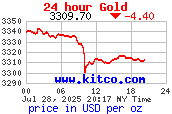
Silver prices were up 16 cents to $36.08 an ounce while the U.S. dollar index was adding 0.51% at $75.41 and the euro was down 0.42% against the dollar.
Despite a stronger U.S. dollar, better-than-expected June same-store sales and stronger U.S. employment data, gold and silver prices were holding onto recent gains. The safe haven metals shrugged off a 25 basis point rate hike from the European Central Bank and the People's Bank of China. Typically when countries take steps to raise rates and tame inflation, gold and silver become less attractive as safe haven assets as the local currency is beefed up.
Gold and silver have been bucking this trend, as investors believe the rate hikes in Europe and China won't have a significant impact on inflation. Speculation is that inflation in China could rise to 6.2% in June, which would mean interest rates are still negative 2.7%.
Gold and silver are attractive in negative interest rate environments as the value of cash is eroded, which makes the metals a safer place to store wealth. The Bank of England left rates unchanged at 0.5% at its meeting Thursday despite the fact that prices rose 4.5% in May.
Gold prices have risen $46 this week on persistent Eurozone sovereign debt fears, the latest rally driven by a Moody's downgrade of Portuguese debt to junk. Some investors are using the two-day climb to take profits in gold but James Moore, research analyst at FastMarkets.com says "the return of Eurozone debt concerns and improved technical picture will lend further support the both gold and silver in the coming sessions," which is providing a floor of support for prices. (kitco.com)
Wednesday, July 6, 2011
Gold May Drop as Strengthening Dollar, Chinese Rate Increase Erode Demand
Gold may decline in New York as a stronger dollar and higher interest rates in China curb demand for an alternative investment.
China said it will raise interest rates from tomorrow for the third time this year after inflation accelerated to the fastest pace since July 2008. The dollar gained against the euro after Moody’s Investors Service cut Portugal’s credit rating to junk status, stoking speculation the nation will need a second bailout. Gold typically moves counter to the greenback.
There is “bearish pressure from potentially higher interest rates,” which increase the opportunity cost of holding bullion, said Filip Petersson, an analyst at SEB AB in Stockholm. “It all comes down to the real interest rate, will it rise or fall? Dollar strength is normally bearish for gold prices.”
Gold for August delivery fell $1, or 0.1 percent, to $1,511.70 an ounce by 8:01 a.m. on the Comex in New York. Immediate-delivery gold was 0.3 percent lower at $1,511.15 in London.
Gold is up 6.4 percent in 2011 after climbing the past 10 years, the longest run of gains in at least nine decades in London. Europe’s debt crisis helped bullion futures reach a record $1,577.40 on May 2.
Moody’s Investors Service yesterday slashed Portugal’s rating four levels to Ba2 with a negative outlook. The decision came two months after Portugal got a 78 billion euro aid package ($112 billion). The cut may further strain relations between the rating companies and European Union policy makers, who are trying to ensure their plan for investor involvement in a new Greek bailout doesn’t trigger a default.
Budget Reduction
The Obama administration and congressional leaders are working to complete a deal on a long-term budget reduction package by July 22. President Barack Obama said he opposes a deficit-cutting measure that would only allow for a short-term increase in the U.S. debt limit as he called a meeting tomorrow with lawmakers to work toward fixes in the government’s finances.
The president’s comments yesterday were the second time in less than a week that he has come to the podium to publicly push lawmakers to secure a deal that addresses basic solutions to deficit spending while averting a first-ever U.S. default on its obligations.
“Portugal’s four-notch ratings downgrade is a reminder that Europe’s debt problems are far from solved,” Edel Tully, a London-based analyst at UBS AG, said in a report. “The focus is increasingly on the U.S. debt ceiling debate. An increasing focus on U.S. fiscal worries should also lead to safe-haven and diversification bids.”
Silver for September delivery fell 0.6 percent to $35.19 an ounce in New York. Palladium for September delivery slipped 0.8 percent to $769.65 an ounce. Platinum for October delivery was down 0.4 percent at $1,735.80 an ounce. (Bloomberg)
China said it will raise interest rates from tomorrow for the third time this year after inflation accelerated to the fastest pace since July 2008. The dollar gained against the euro after Moody’s Investors Service cut Portugal’s credit rating to junk status, stoking speculation the nation will need a second bailout. Gold typically moves counter to the greenback.
There is “bearish pressure from potentially higher interest rates,” which increase the opportunity cost of holding bullion, said Filip Petersson, an analyst at SEB AB in Stockholm. “It all comes down to the real interest rate, will it rise or fall? Dollar strength is normally bearish for gold prices.”
Gold for August delivery fell $1, or 0.1 percent, to $1,511.70 an ounce by 8:01 a.m. on the Comex in New York. Immediate-delivery gold was 0.3 percent lower at $1,511.15 in London.
Gold is up 6.4 percent in 2011 after climbing the past 10 years, the longest run of gains in at least nine decades in London. Europe’s debt crisis helped bullion futures reach a record $1,577.40 on May 2.
Moody’s Investors Service yesterday slashed Portugal’s rating four levels to Ba2 with a negative outlook. The decision came two months after Portugal got a 78 billion euro aid package ($112 billion). The cut may further strain relations between the rating companies and European Union policy makers, who are trying to ensure their plan for investor involvement in a new Greek bailout doesn’t trigger a default.
Budget Reduction
The Obama administration and congressional leaders are working to complete a deal on a long-term budget reduction package by July 22. President Barack Obama said he opposes a deficit-cutting measure that would only allow for a short-term increase in the U.S. debt limit as he called a meeting tomorrow with lawmakers to work toward fixes in the government’s finances.
The president’s comments yesterday were the second time in less than a week that he has come to the podium to publicly push lawmakers to secure a deal that addresses basic solutions to deficit spending while averting a first-ever U.S. default on its obligations.
“Portugal’s four-notch ratings downgrade is a reminder that Europe’s debt problems are far from solved,” Edel Tully, a London-based analyst at UBS AG, said in a report. “The focus is increasingly on the U.S. debt ceiling debate. An increasing focus on U.S. fiscal worries should also lead to safe-haven and diversification bids.”
Silver for September delivery fell 0.6 percent to $35.19 an ounce in New York. Palladium for September delivery slipped 0.8 percent to $769.65 an ounce. Platinum for October delivery was down 0.4 percent at $1,735.80 an ounce. (Bloomberg)
Subscribe to:
Posts (Atom)